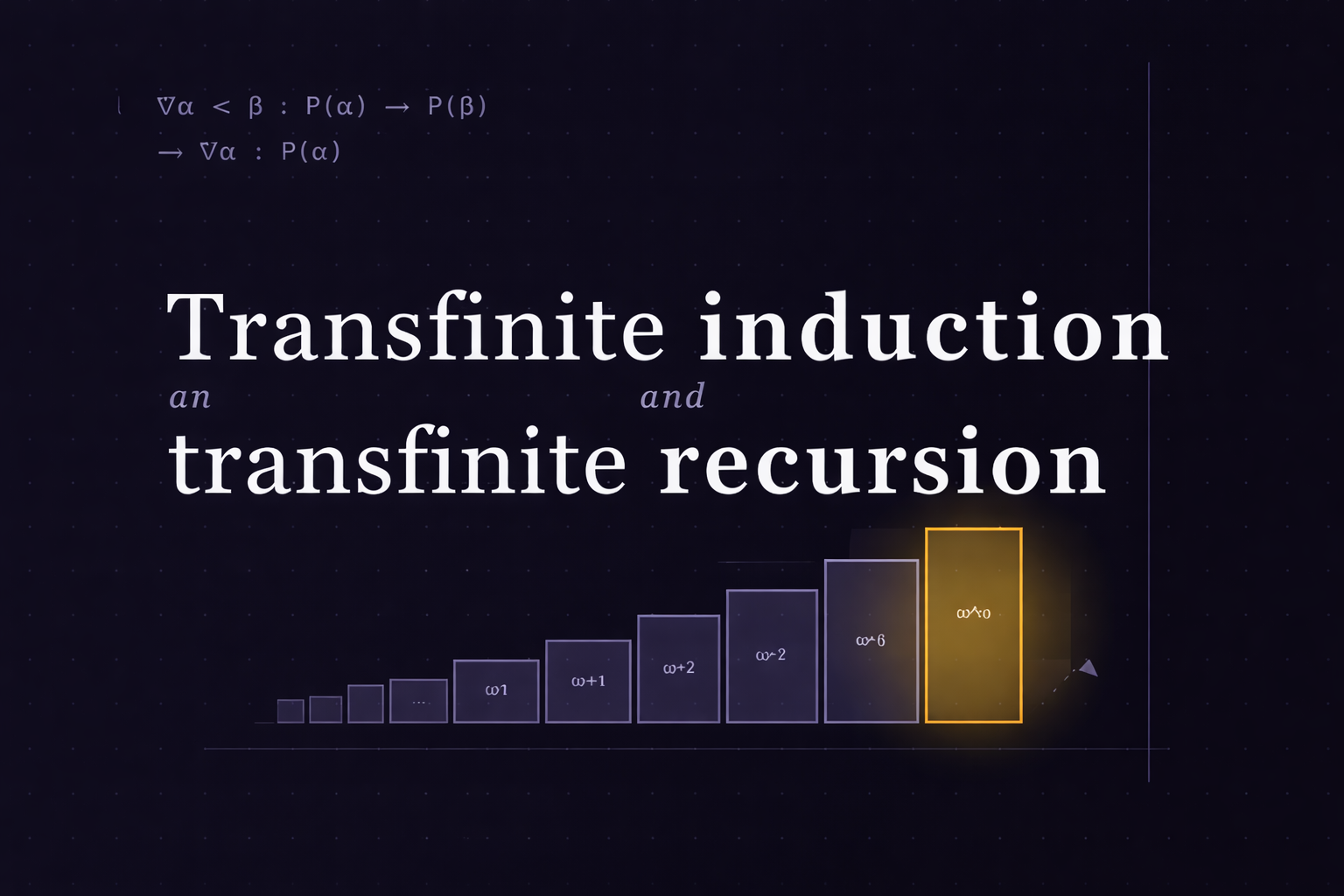
1. Transfinite Induction
Theorem. Let $P$ be a property defined on ordinals, and suppose that for any $\alpha \in \mathrm{Ord}$,
\[[ \forall \beta < \alpha : P(\beta)] → P(\alpha).\]Then $P$ is true for all ordinals.
Remark. Since $\mathrm{Ord}$, the domain of $P$, is a proper class rather than a set, we use the term “property” instead of “predicate”.
Proof. Suppose there exists $\lambda$ such that $\lnot P(\lambda)$. Then $\Omega = \lbrace \alpha \in \lambda : \lnot P(\alpha) \rbrace$ is a non-empty well-ordered set, so it has a minimal element $\alpha_0$. Since $\forall \beta < \alpha_0 : P(\beta)$, by hypothesis we have $P(\alpha_0)$, which is a contradiction. ■
Application. Show that the von Neumann hierarchy may be defined as $V_{\alpha + 1} = \mathcal{P}(V_\alpha)$ instead of $V_{\alpha + 1} = V_\alpha \cup \mathcal{P}(V_\alpha)$.
2. Transfinite Recursive Definition
Motivation. Consider recursive definitions on natural numbers. Given $n$ sets $x_1, \dots , x_n$ and a function $g$ that outputs a set, we would like to define $f: \mathbb{N} → V$ as follows:
\[f(n) = g(f(0), \dots, f(n - 1))\]The problem is that $g$ can only take a fixed number of parameters. Therefore, we group the parameters of $g$ into an ordered pair:
\[f(n) = g(\langle f(0), \dots, f(n - 1) \rangle)\]This ordered pair can be represented as $\lbrace (0, f(0)), \dots, (n - 1, f(n - 1)) \rbrace = f \upharpoonright n$. That is,
\[f(n) = g(f \upharpoonright n).\]Generalising this to ordinals, we obtain the following:
Theorem. Let $G: V → V$ be a class function. There exists a class function $F: \mathrm{Ord} → V$ satisfying
\[F(\alpha) = G(F \upharpoonright \alpha)\]
Proof. Apply transfinite induction extensively. (Sorry for the brevity, lol.) It is worth remarking that the proof does not depend on the axiom of choice, for the well-orderedness of ordinals is provable from ZF. Note, however, that the proof that every well-ordered set is order isomorophic to an ordinal does require AC.